Welding positions explained: from 1G to 6G
Welding positions describe how the joint is oriented relative to gravity. On plate there are four: flat (1), horizontal (2), vertical (3) and overhead (4). Pipe adds the 5G (fixed horizontal pipe) and 6G (pipe inclined at 45 degrees). The letter marks the joint type: G for groove and F for fillet.
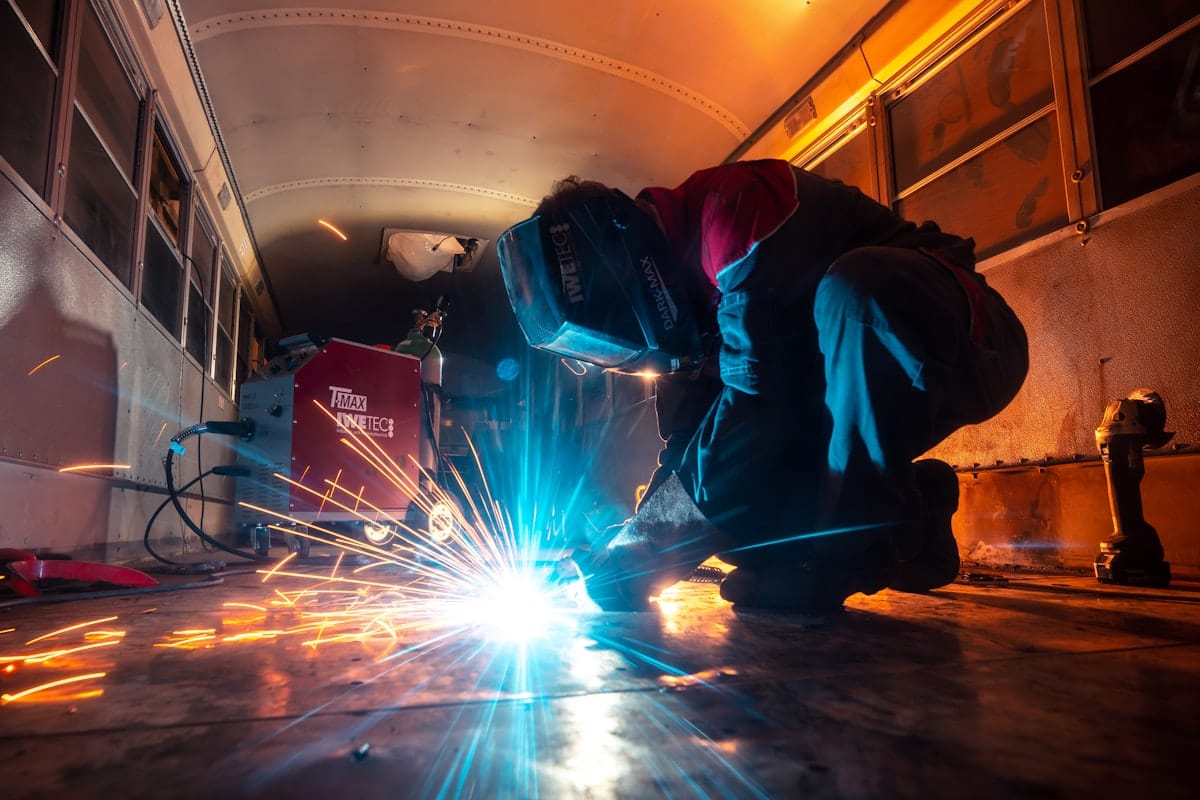
The same welder can sign off a flawless bead on a shop bench and, half an hour later, fight that same joint once it’s over their head. It isn’t that they suddenly know less: it’s the position. How the joint sits relative to gravity decides how molten metal falls, what current you can run and how much skill it takes. This guide walks the welding positions from 1G to 6G with diagrams, technique tables and a step-by-step, so you understand not just what they’re called but how they’re welded.
What is a welding position?
A welding position describes how the joint is oriented relative to gravity and the welder. It’s named with a number and a letter. The number gives the tilt (1 flat, 2 horizontal, 3 vertical, 4 overhead) and the letter gives the joint type: G for groove (butt joint) and F for fillet (angle joint). So a 3F is a fillet welded vertically, and a 2G is a butt joint welded horizontally.
Before you climb the scaffold it pays to be clear on that G-versus-F difference, because each is qualified separately and behaves differently.
Positions aren’t invented shop by shop: they’re defined by codes. The American world uses AWS D1.1 and ASME Section IX (1G, 2G, 5G…); the European world uses ISO 6947 (PA, PC, PF…). Further down you’ll find a table that translates one system into the other. If you’re starting further back, begin with what industrial welding is and the types of welding and when to use each process.
What decides the position you weld in?
The position isn’t always a choice: often the job dictates it. An erected tank or pipe in a rack can’t be spun, so you weld it where it stands. When you can choose, these factors weigh in:
- Joint design. A butt joint (G) and a fillet (F) don’t behave the same in the same orientation.
- Process. Stick (SMAW) and flux-cored (FCAW) handle vertical and overhead well; MIG (GMAW) struggles more because of its high heat input.
- Material thickness. The thicker the section, the more passes, and the more position matters for heat control.
- Welder skill. Not everyone is qualified in every position; 6G is territory for the most experienced hands.
- Productivity. Flat deposits fastest, so whenever a part can be positioned flat, it is.
Plate welding positions (1G to 4G)
Plate has four basic positions, from most comfortable to most demanding, because gravity works harder against the weld pool at each step.
Flat (1G / 1F)
The joint is horizontal and welded from above. It’s the most comfortable and productive position: gravity helps the molten metal settle into the pool, allows higher currents and higher deposition rates. In 1F the electrode sits at about 45° between the two fillet plates; in 1G you work nearly perpendicular with a slight 10–15° drag angle.
| Aspect | Detail |
|---|---|
| Typical angle | 1G perpendicular, 10–15° drag · 1F at 45° between plates |
| Advantage | Maximum ease, high deposition, works with SMAW, MIG, TIG and FCAW |
| Challenge | Almost none; watch over-deposition from high current |
| Application | Shop work, positionable parts, bases and frames |
Horizontal (2G / 2F)
The weld axis is horizontal but the joint face is vertical. Here gravity starts to pull the pool downward, so two typical defects appear: undercut at the top edge and a sagging bead. You control it with a slight 5–15° upward angle and, if needed, a light whipping motion to spread the heat.
| Aspect | Recommendation | Objective |
|---|---|---|
| Work angle | 5–15° upward | Counter gravity |
| Manipulation | Light whipping if needed | Distribute heat |
| Current | Match to thickness | Prevent undercut and sag |
| Thick sections | Multiple passes | Build the bead gradually |
Vertical (3G / 3F)
The joint runs vertically and can be welded uphill (up) or downhill (down). They aren’t interchangeable: each has its place.
| Uphill (3G-U) | Downhill (3G-D) | |
|---|---|---|
| Direction | Bottom to top | Top to bottom |
| Penetration | Higher | Lower |
| Best for | Sections > 5 mm | Thin sheet |
| Speed | Slower | Faster |
| Risk | Fatigue, over-deposition | Lack of fusion if run too fast |
Uphill gives more penetration because the pool rests on the metal already solidified below it; that’s why it’s the choice on heavy structure. Downhill travels fast with low heat input, ideal for thin sheet where you’d otherwise burn through.
Overhead (4G / 4F)
The joint is above the welder and welded looking up. It’s the most demanding plate position: gravity pushes molten metal toward the floor, with a risk of dripping and a sagging pool. You work with a short arc, reduced current, small beads and fast travel so the metal solidifies before it falls. It also demands the most protective equipment, because slag and spatter fall onto the operator.
| Parameter | Technique | Purpose |
|---|---|---|
| Arc & current | Short arc, reduced current | Keep the pool small |
| Electrode angle | Near perpendicular, slight drag | Support the pool |
| Manipulation | Short, rapid beads | Allow it to solidify |
| Safety | Reinforced PPE | Guard against drip and slag |
Pipe welding positions (5G, 6G and 6GR)
Pipe adds its own positions because the bead wraps a tube and, in a single lap, passes through several orientations at once. Mastering one position is no longer enough: you have to chain them without breaking the bead.
5G — fixed horizontal pipe
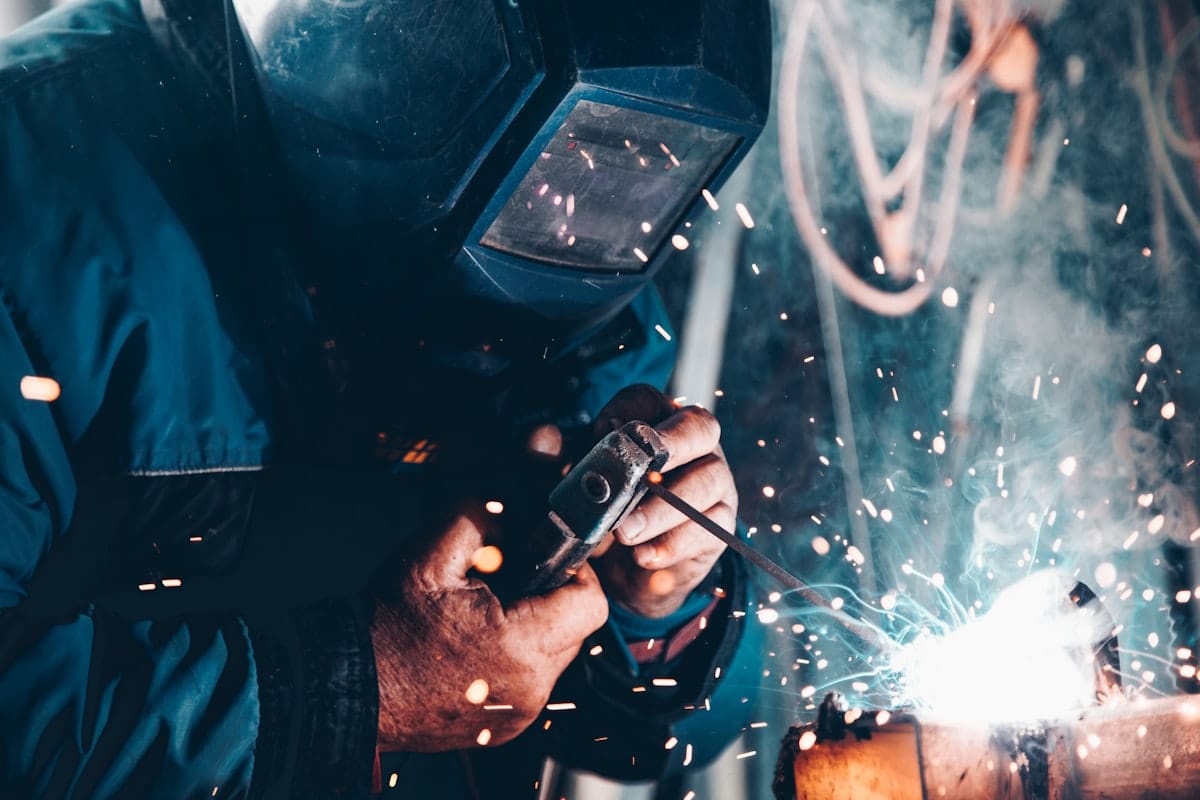
In 5G the pipe is fixed horizontal and can’t be turned: the welder moves around it. In one 360° lap the bead runs through flat at the top, vertical on the sides and overhead at the bottom. That already makes a 5G a complete pool-control exercise.
Thinking of the pipe as a clock, the usual progression is:
- 12 o’clock — flat (1G) Comfortable start, standard push or drag.
- Side down — vertical downhill (3G-D) Short arc and speed to avoid piling metal.
- 6 o’clock — overhead (4G) Very short arc, minimal deposition, the most delicate zone.
- Side up — vertical uphill (3G-U) Whipping motion, slower, to close with penetration.
6G — fixed pipe at 45°
In 6G the pipe is fixed and inclined at 45° to the horizontal plane. It combines every difficulty at once, because in a single bead the welder crosses flat, vertical and overhead without being able to reposition the part. That’s why a 6G qualification is the most prized in the trade: passing it proves control of every orientation.
A typical 6G procedure, step by step:
- Alignment and fit-up Set the fit-up within tolerance, with a uniform root gap.
- Root pass Whipping or «tree» technique for full penetration without blowing through.
- Fill passes Straight beads or light weaving, controlling heat input segment by segment.
- Cap pass A uniform bead, free of undercut or over-reinforcement.
- Purge and control On critical work, purge with inert gas (argon) and inspect the root.
6GR adds a restriction ring that simulates welding close to another member, as in real pipe racks where there’s no room to maneuver. It’s even more demanding and is used to qualify dense structural work.
Equivalence table: AWS/ASME versus ISO 6947
The same movement has two names depending on the code. If you work in the Caribbean with both American and European clients, this translation saves misunderstandings in procedures (WPS) and qualifications (WPQ).
| Position | AWS / ASME | ISO 6947 | Joint |
|---|---|---|---|
| Flat | 1G / 1F | PA | Groove and fillet |
| Horizontal (fillet) | 2F | PB | Fillet |
| Horizontal (groove) | 2G | PC | Butt |
| Overhead (fillet) | 4F | PD | Fillet |
| Overhead (groove) | 4G | PE | Butt |
| Vertical uphill | 3G-U / 3F-U | PF | Groove and fillet |
| Vertical downhill | 3G-D / 3F-D | PG | Groove and fillet |
| Fixed horizontal pipe | 5G | PF (up) / PG (down) | Butt |
| Fixed pipe at 45° | 6G | H-L045 | Butt |
Why position changes everything
Position isn’t a bureaucratic detail: it decides technique, heat input, even the process. The more you fight gravity, the smaller the weld pool must be so it doesn’t sag, and the slower you travel. That’s why a joint that’s perfect flat can fill with defects overhead if parameters and technique aren’t adjusted.
That ladder is also a learning plan. A welder trains from the bottom up: first flat and horizontal, then vertical, then overhead and finally pipe 5G and 6G. Controlling the pool in each position is one of the keys we cover in how to achieve quality welds. At TAS we weld in every one of them, in the shop and in the field, with our industrial welding team.
Common defects by position and how to avoid them
Each position has its signature defect. Spotting it early is the difference between repairing a bead and rejecting a whole joint.
| Position | Common defect | Cause | Fix |
|---|---|---|---|
| Flat | Over-reinforcement | Excess current or deposition | Lower current, raise travel speed |
| Horizontal | Top undercut / sag | Gravity on the pool | 5–15° upward angle, light whip |
| Vertical | Lack of fusion | Traveling too fast | Uphill on thick, control speed |
| Overhead | Dripping / porosity | Large pool, long arc | Short arc, low current, short beads |
| 5G / 6G | No root penetration | Fit-up or root technique | Uniform gap, controlled whip |
Positions and welder qualification
Positions aren’t just technique: they’re the basis of qualification. A welder is certified in a specific position under AWS D1.1 or ASME Section IX, and that qualification covers others by a simple rule: the harder one usually qualifies the easier ones.
- Passing a 1G qualifies you for flat only.
- A 3G + 4G usually covers flat, horizontal, vertical and overhead on plate.
- A 6G on pipe usually qualifies all plate positions and the 5G, because every orientation has already been proven.
So when a project calls for a WPS and a PQR, the test position is chosen carefully: it defines what each welder can weld on site. Hiring a «6G» welder isn’t bragging: it’s the guarantee that the person can take on the hardest joint in the project.
- Position describes joint orientation; the number gives tilt and the letter the joint type (G groove, F fillet).
- On plate: flat (1), horizontal (2), vertical (3) and overhead (4), easy to hard.
- On pipe: 5G (fixed horizontal pipe) and 6G (pipe at 45°), the most demanding.
- AWS/ASME (1G-6G) and ISO 6947 (PA-PG, H-L045) name the same positions differently.
- The test position sets the qualification: the hardest (6G) qualifies the easier ones.
Frequently asked questions
Need welding in any position?
TAS welds flat, vertical, overhead and pipe (5G/6G) to AWS D1.1, ASME IX and ISO 6947, in the shop and in the field, across the Caribbean.
Request a quoteView industrial welding EN
EN ES
ES