What Is Industrial Welding? A Complete Guide
Industrial welding is the process of joining metal permanently, using heat, pressure or both, to fabricate and repair structures, tanks, pipes and equipment for sectors like refineries, construction, shipbuilding and petrochemicals. It differs from ordinary welding by its scale, its structural responsibility, and the codes (AWS, ASME, API) a qualified welder must follow.
Look at any steel structure, storage tank, refinery pipe or ship’s hull and you are looking at welding. Industrial welding is the invisible technique that holds heavy industry together. And yet, few people know what sets it apart from the welding at a neighborhood shop. This guide covers what it is, how it works, the main types, where it is used, and the codes it has to meet to be trusted.
What is industrial welding?
Industrial welding is the permanent joining of two or more pieces of metal by applying heat, pressure or both until they fuse into one piece. It is a pillar of the real economy: welding powers more than a quarter of global manufacturing and accounts for around 2% of world GDP (Gitnux, 2026).
Three elements come into play. The base metal is the parts being joined. The filler metal is the metal added to fill the joint. And the weld bead is the line of solidified metal left once it cools. When the work is done right, the joint ends up as strong as the parent metal, or stronger.
How does it differ from ordinary welding?
The difference is not the machine, it is what is at stake. A bad weld on a garden gate is just an eyesore. The same flaw in a refinery tank or a beam holding up a building can cause a leak, a collapse, or worse. That is why industrial welding runs on strict codes, gets done by certified personnel, and almost always passes an inspection before it goes into service.
How industrial welding works: the arc and the weld pool
Most industrial welding is arc welding. An electric current jumps a small gap between an electrode and the metal, creating an arc that burns near 6,500°F (about 3,600°C), hot enough to melt steel on contact (Wikipedia). That heat forms a weld pool which, as it cools, leaves the two parts fused into one.
Here is the detail that decides the result: the shield. Molten steel reacts with oxygen and nitrogen in the air and fills with pinholes. To prevent that, some processes use a shielding gas and others a flux that burns and makes its own protective atmosphere. That choice drives how clean the weld is and whether you can weld outdoors or only in the shop.
How many types of industrial welding are there?
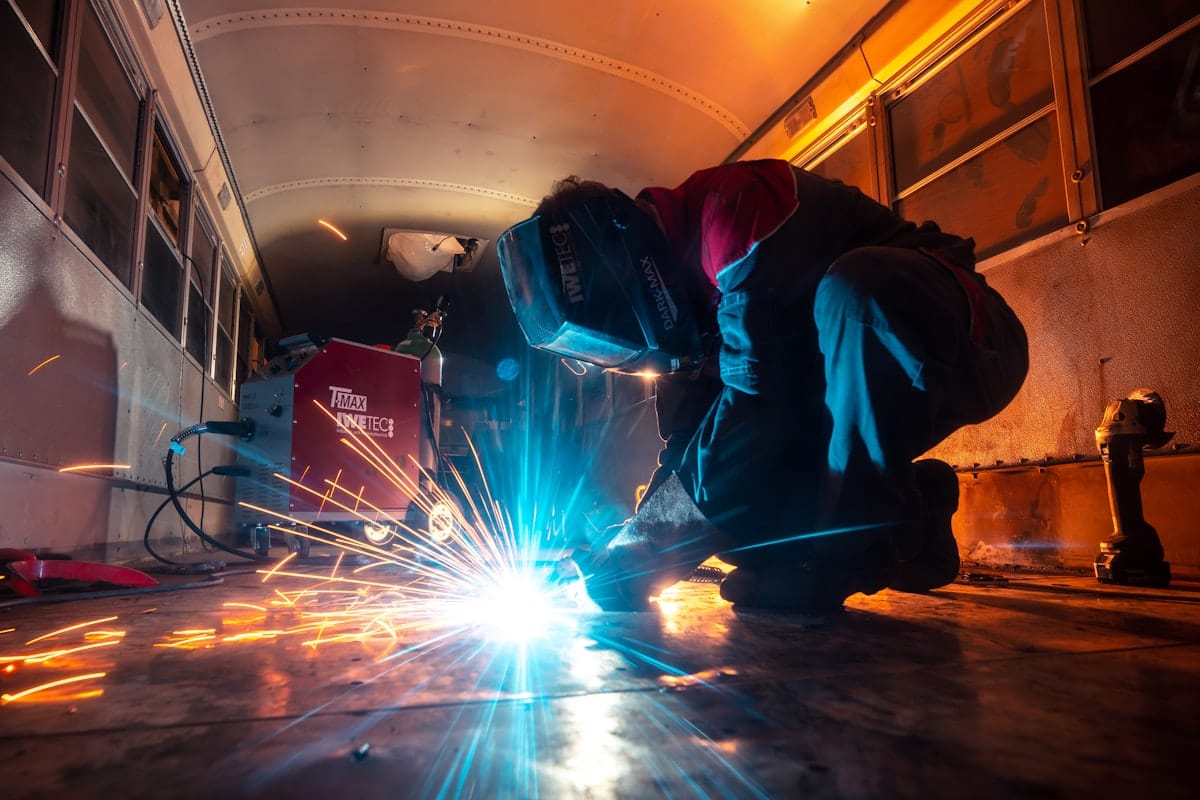
In practice there are more than eight types of industrial welding, though most of the work falls to four arc processes. Around 85% of infrastructure projects use arc welding as the primary joining method for steel (Gitnux, 2026). These are the eight processes that dominate industry, ordered by how often they are used:
The most versatile and portable. The electrode shields the pool with its own flux, no gas bottle needed. It rules field work, structural erection and repair on rusty or painted steel.
Feeds a continuous wire under a shielding gas. It is the fastest and easiest to learn, ideal for shop work and production runs on carbon steel.
The cleanest and most precise. It uses a tungsten electrode and hand-fed filler under argon. Essential for stainless steel, aluminum and thin-wall tube.
Like MIG, but with a wire filled with flux. It offers a very high deposition rate on thick steel and holds up in the wind on site.
An automated process that works under a blanket of powdered flux. It leaves long, clean, deep-penetration welds on tanks, girders and large vessels.
Joins sheets with pressure and current, with no filler metal. It dominates the auto industry and thin-sheet assembly.
Concentrates the arc into a fine plasma jet. It brings high precision and penetration to demanding industrial and automated welding.
Fires a high-energy beam for fine, highly accurate joints with very little distortion. Common in high-end production and precision components.
Which one fits a given job? It depends on the metal, the thickness, the position and the finish. The first four (stick, MIG, TIG and flux-cored) cover the vast majority of custom fabrication. We compare them in depth, table included, in our guide to types of welding: MIG, TIG and stick.
Applications of industrial welding: where it is used
Industrial welding sits inside almost everything that holds heavy industry up. Roughly 80% of the structural components in heavy machinery are joined using arc welding processes (Gitnux, 2026). These are the fronts where it works hardest.
In structural steel, welding assembles the beams, columns and frames that carry buildings and plants. In tank fabrication, it joins the shell courses and floor of leak-tight storage tanks. In refineries and petrochemical plants, it seals pipes and pressure equipment that run at the limit. And in the marine sector, it keeps hulls and decks sound against the sea.
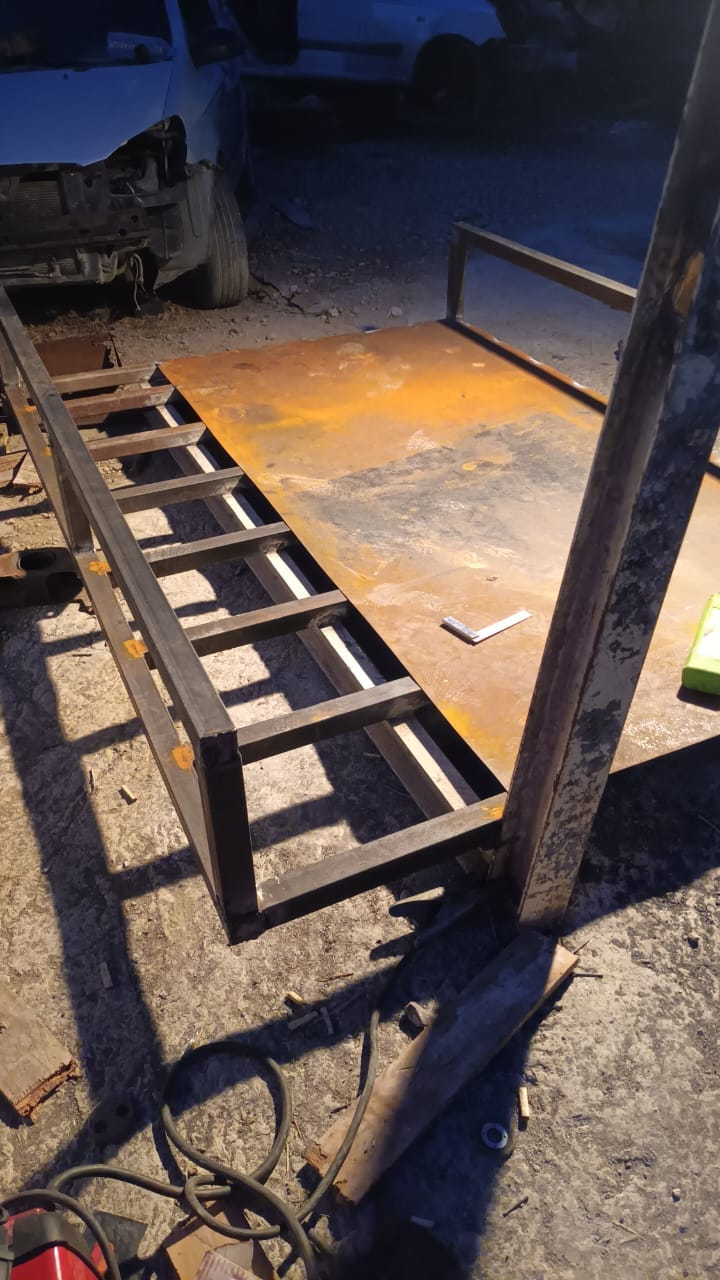
At TAS we see it every day. The structure in the photo, a heavy equipment base, came out of our shop: steel plate cut, fitted and welded onto a structural frame, ready to carry load. That is what industrial welding really looks like, far from the theory.
Codes and certification: what makes a weld industrial
What separates an industrial weld from a backyard one is not the spark, it is the paperwork behind it. An industrial weld follows a code, gets made by a qualified welder, and is verified. Skip those three steps and, however pretty the bead looks, it is not a trustworthy industrial weld.
The most common codes are AWS D1.1 for structural steel, ASME Section IX for pressure equipment, and the API standards for tanks and pipelines. Each joint is defined in a welding procedure (WPS) that sets the filler, current and technique, and the welder must be certified to that procedure. Then come the non-destructive tests, like radiography or dye penetrant, which catch a pinhole or lack of fusion before the equipment goes live.
Why all the control? Because in an environment like the Caribbean, with salt air and humidity, a weak weld corrodes and fails far sooner. You can go deeper on this in our guide to AWS welding certification standards for the Caribbean.
How to spot a quality industrial weld
A good weld shows concrete signs: a uniform bead with no pinholes, solid penetration into the base metal, and no cracks or undercut at the edges. But the most reliable sign is not in the metal, it is in who welded it and the documentation that comes with it.
If you are hiring, ask about the welder’s certifications, the applicable WPS and the inspection plan. A serious provider has them and shows them. At TAS we run every process to code with our industrial welding team, and when a project needs more certified hands we also supply qualified welders across the region.
- Industrial welding joins metal permanently to fabricate and repair structures, tanks and pipes.
- It differs from ordinary welding by its scale, structural responsibility and the codes it meets.
- Most of it is arc welding: stick (SMAW), MIG, TIG and flux-cored.
- It is used in structural steel, tanks, refineries, pipelines and shipbuilding.
- A weld is industrial when it follows a code (AWS, ASME, API), a qualified welder makes it, and it is inspected.
Frequently Asked Questions
Need industrial welding in the Caribbean?
TAS runs certified industrial welding to AWS D1.1 and ASME IX, in the shop and on site across Sint Maarten and the region.
Request a Quote View Welding Service EN
EN ES
ES