Types of Welding Explained: MIG vs TIG vs Stick vs Flux-Cored
The four main types of welding are MIG (GMAW), TIG (GTAW), stick (SMAW) and flux-cored (FCAW). MIG runs fast and easy for shop fabrication. TIG gives the cleanest, most precise weld on stainless steel and aluminum. Stick is portable and shrugs off wind and rust. Flux-cored pours on weld metal for heavy steel. They all fuse metal with an electric arc; what changes is how the filler is fed and how the weld pool is protected from the air.
MIG, TIG, stick, flux-cored. Four names for machines that all do one basic job: they melt metal with an electric arc and fuse two pieces into one. So why do welders argue for hours about which one to reach for? Because each process trades speed, cleanliness, portability and cost in its own way. Pick the wrong one and you walk away with a weak weld, a slow job, or an invoice that ran higher than it needed to. This guide breaks down how the four main welding methods work, what each does best, and how to match the right process to your project.
How arc welding works: the arc, the weld pool and the shield
Every process here is a form of arc welding. An electric current jumps a tiny gap between an electrode and the base metal, creating an arc that burns near 6,500°F (about 3,600°C), hot enough to melt steel almost instantly (Wikipedia). That heat forms a molten weld pool, and as it cools the two parts solidify as one piece of metal.
Two things separate the four methods. The first is the filler metal: how fresh metal gets added to the joint. Some processes feed a wire automatically, one melts a hand-held rod, another consumes a coated stick. The second, and the one that matters most on a job site, is the shield.
Molten steel hates open air. Oxygen and nitrogen rush into an unprotected weld pool and leave it full of pinholes, a defect welders call porosity. So every process shields the pool somehow. MIG and TIG blow a curtain of inert gas over it, usually argon or a CO2 blend. Stick and flux-cored skip the gas bottle and carry their own flux instead, which burns to make shielding vapor and leaves a crust of slag you chip off afterward. Gas keeps the weld clean; flux keeps it protected when the wind would blow a gas shield away.
MIG welding (GMAW): fast wire-feed welding for shop fabrication
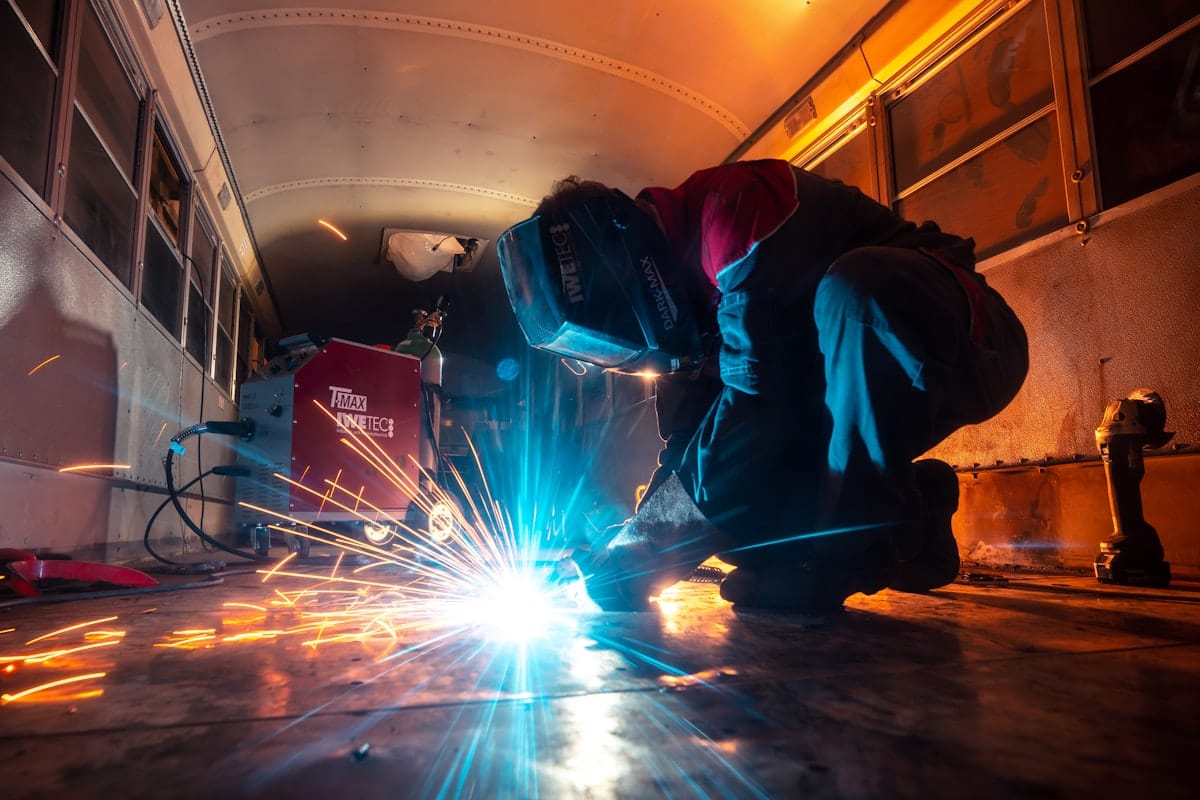
MIG, short for Gas Metal Arc Welding (GMAW), is the wire-feed workhorse of the fabrication shop. A motor pushes a continuous solid wire through the gun while a shielding gas protects the weld pool, so the welder just squeezes the trigger and guides the bead. It runs faster than any hand-fed method and takes the least practice to learn (ESAB).
How MIG welding works
The wire doubles as electrode and filler. As it feeds into the arc it melts into the joint, so the welder never stops to change rods. A gas mix (CO2 for mild steel, argon blends for a smoother arc) shields the pool, which means almost no slag and very little cleanup. That continuous feed is why MIG lays metal down so quickly on long, repetitive seams.
Where MIG wins, and where it struggles
MIG owns the shop. It is the natural pick for production runs, trailers, brackets, sheet metal and general carbon-steel fabrication where the work stays indoors. The weakness is that same shielding gas. Step outside and a light breeze scatters it, so the weld fills with porosity. MIG also asks for clean, prepped metal; it does not like rust or paint. Keep it indoors on tidy steel and few processes are faster.
TIG welding (GTAW): precision welding for stainless steel and aluminum
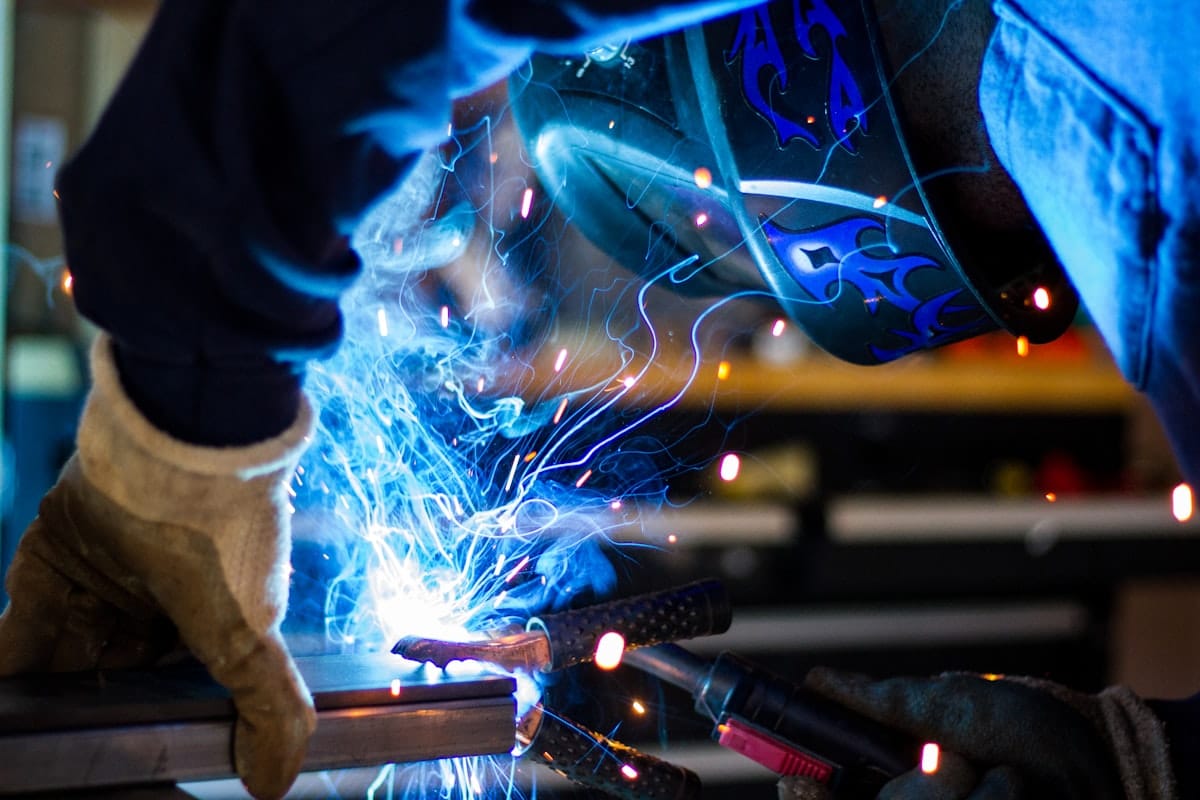
TIG, or Gas Tungsten Arc Welding (GTAW), is the precision instrument of the group. A non-consumable tungsten electrode holds the arc under a pure argon shield while the welder dips a filler rod into the pool by hand, one small bead at a time. The payoff is the cleanest weld you can make: no spatter, no slag, and a bead so neat it often needs zero grinding.
How TIG welding works
Unlike MIG, the electrode does not melt. The tungsten only creates the arc; the welder adds filler separately with the other hand and usually controls the heat with a foot pedal. That gives fine command over the weld pool, which is exactly what thin metal and exotic alloys need. Argon shielding keeps reactive metals like aluminum and titanium from oxidizing as they cool.
Best jobs for TIG welding
What does that precision buy you? Control over heat input, which is everything on thin-wall tube, stainless steel and aluminum. TIG rules sanitary and food-grade piping, pressure vessels, aerospace parts and any joint that has to look flawless on show. The trade-off is speed and skill. TIG is the slowest process and the hardest to master, so it costs more per inch of weld. You use it where quality is not negotiable, not where you need to cover ground fast.
Stick welding (SMAW): portable arc welding for field and structural work
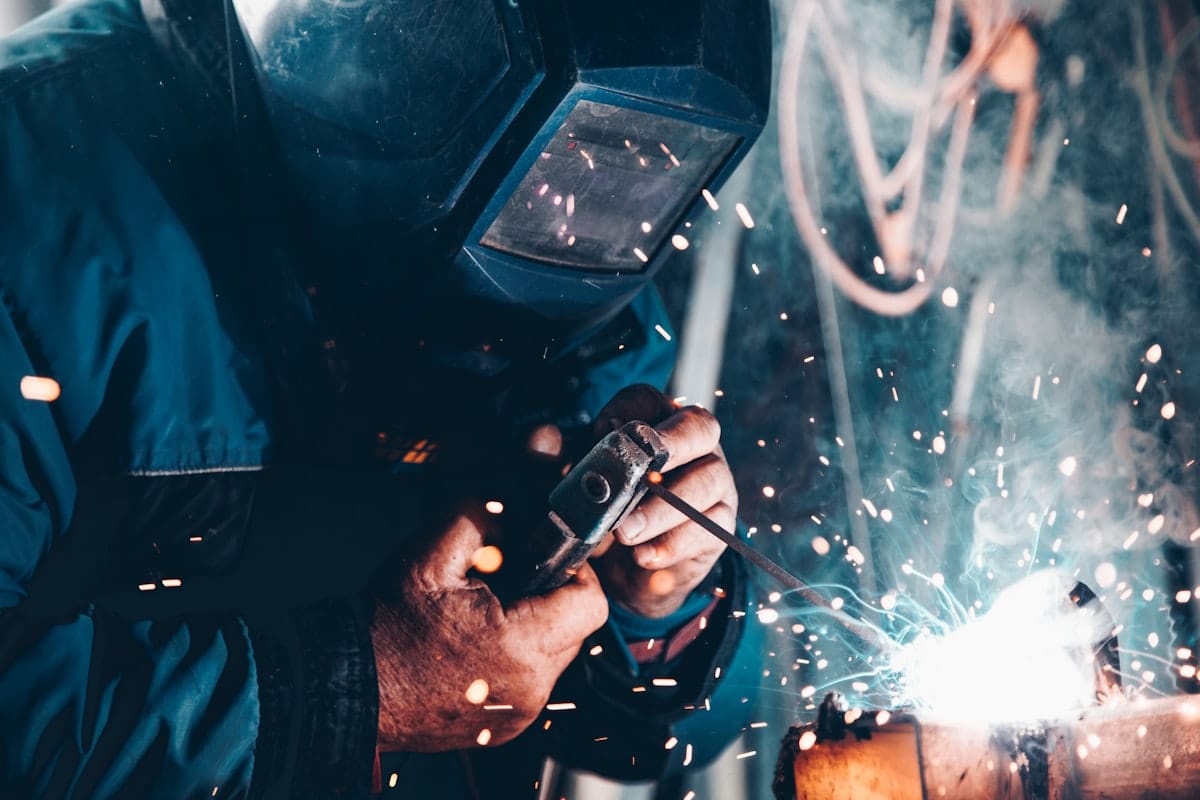
Stick welding, formally Shielded Metal Arc Welding (SMAW), is the rugged veteran that goes anywhere. A flux-coated electrode, the “stick,” carries the current and melts into the joint, while its burning coating shields the pool and leaves slag behind. There is no gas bottle and no wire feeder to haul, just a power source, a lead and a box of rods.
How stick welding works
The electrode is consumable: it becomes the filler as it burns down, so the welder swaps in a new rod every minute or so. The flux coating does double duty, releasing shielding gas and forming slag that protects the cooling bead. Once the weld cools, you chip and brush the slag away to reveal the metal underneath.
Why stick welding still rules outdoor jobs
Simplicity is the whole point. Because the shield comes from the flux, not a gas bottle, stick welds happily outdoors, in wind, in the rain, and in every position from flat to overhead. It also bites through surface rust, mill scale and paint that would ruin a MIG weld. For field repairs, structural steel erection and pipeline work across the Caribbean, where you rarely get a clean workshop, stick is still the backbone. It is not the prettiest weld, but it is the one that gets made when conditions are rough.
Flux-cored welding (FCAW): high-deposition welding for heavy steel
Flux-Cored Arc Welding (FCAW) is MIG’s tougher cousin. It runs off a wire feeder just like MIG, but the wire is a hollow tube packed with flux instead of a solid strand. Self-shielded versions need no gas bottle at all, which lets FCAW combine the speed of a wire feed with the wind tolerance of stick, leaving slag behind the same way.
The big draw is deposition rate: flux-cored simply lays down more weld metal per minute than the other processes, which is gold on thick plate and heavy structural steel. Site crews love it for building beams, columns and heavy frames outdoors, where a gas shield would be impractical but the job still needs to move fast. When you have to weld thick material quickly in the open air, FCAW usually gets the call.
MIG vs TIG vs stick vs flux-cored: welding process comparison chart
Here is how the four types of welding stack up on the factors that decide a job. Read it as a shortlist tool: find the row that matters most for your project, then see which process fits.
| MIG (GMAW) | TIG (GTAW) | Stick (SMAW) | Flux-Cored (FCAW) | |
|---|---|---|---|---|
| Filler metal | Continuous solid wire | Hand-fed rod | Coated electrode | Tubular flux wire |
| Shielding | Gas | Gas (argon) | Flux (gasless) | Flux (often gasless) |
| Slag to clean | Little to none | None | Yes | Yes |
| Welding speed | Fast | Slow | Moderate | Very fast |
| Skill to learn | Low | High | Moderate | Moderate |
| Outdoor and wind | Poor | Poor | Excellent | Excellent |
| Best base metals | Carbon and stainless steel | Stainless, aluminum, thin tube | Carbon and low-alloy steel | Thick carbon steel |
| Typical use | Shop fabrication, production | Precision and cosmetic welds | Field and structural repair | Heavy structural, thick plate |
How to choose a welding process for your project
Four questions settle almost every choice: what is the base metal, how thick is it, where will the work happen, and how good does the weld have to look? Answer those and the process usually picks itself.
Start with the base metal
The metal narrows the field fast. Stainless steel or aluminum that has to stay clean points straight to TIG, with MIG as a faster option on thicker stainless. Plain carbon steel opens up all four. If a joint is thin, TIG gives you the heat control to avoid burning through; if it is thick, flux-cored or stick puts down metal without endless passes.
Then weigh thickness, position and location
Where and how you weld matters as much as the metal. Indoors on a bench with clean steel? MIG is fastest. Out on a structure in the Caribbean trade winds? Stick or flux-cored, every time, because their flux shield ignores the breeze. Overhead or vertical positions favor stick. Thick site welds that need to move quickly favor flux-cored. In real projects you rarely use just one. A tank might be MIG-welded in the shop, stick-welded during field erection, and TIG-welded on its critical stainless connections. Matching the process to each part of the job is a big part of what a professional welding team brings to the table.
Weld quality and welding certification: the process is only half the job
Here is the part the comparison charts leave out. The process you pick does not make a weld strong. A qualified welder following an approved procedure does. Two people can run the same MIG machine and get two very different welds, and only one of them passes inspection.
That is why industrial work runs on codes. A welding procedure specification (WPS) sets the exact filler, current, gas and technique for a given joint, and the welder has to be certified to that procedure under a standard such as AWS D1.1 for structural steel or ASME Section IX for pressure work. On refinery and marine projects around Sint Maarten, welds also face non-destructive testing, so a hidden pinhole or lack of fusion gets caught before the equipment ever goes into service. Salt air and humidity only raise the stakes, since a weak weld corrodes and fails faster in a Caribbean environment.
So treat the process as step one, not the finish line. Choose MIG, TIG, stick or flux-cored to suit the metal and the setting, then make sure a certified welder runs it to the right code. Our team welds all four processes to AWS D1.1 and ASME IX, our welding certification guide walks through the standards in detail, and when a project needs more certified hands we also supply qualified welders across the region.
- The four types of welding (MIG, TIG, stick, flux-cored) are all arc processes; they differ in filler feed and shielding.
- MIG is the fast, easy pick for shop fabrication on clean carbon steel.
- TIG gives the cleanest, most precise weld on stainless steel, aluminum and thin metal.
- Stick and flux-cored use flux instead of gas, so they weld outdoors, in wind and on rusty steel.
- Choose by base metal, thickness, position and finish. Most real projects use more than one process.
- A weld is only as strong as the welder and the code behind it, not the process name.
Frequently Asked Questions
Need certified welding across the Caribbean?
TAS runs MIG, TIG, stick and flux-cored to AWS D1.1 and ASME IX as part of our industrial welding service, in the shop and on site across Sint Maarten and the region.
Request a Quote View Welding Services EN
EN ES
ES