Structural steel shapes: types, profiles and how to choose
Structural steel shapes are the rolled profiles steel is produced in to carry load: the W wide-flange beam, the S standard I-beam, the HP bearing pile, the C channel, the L angle, the HSS hollow tube, plate and bar. Each shape has a job: W-shapes make beams and columns, HSS resist torsion, angles and channels build bracing, and plates form base plates and connections.
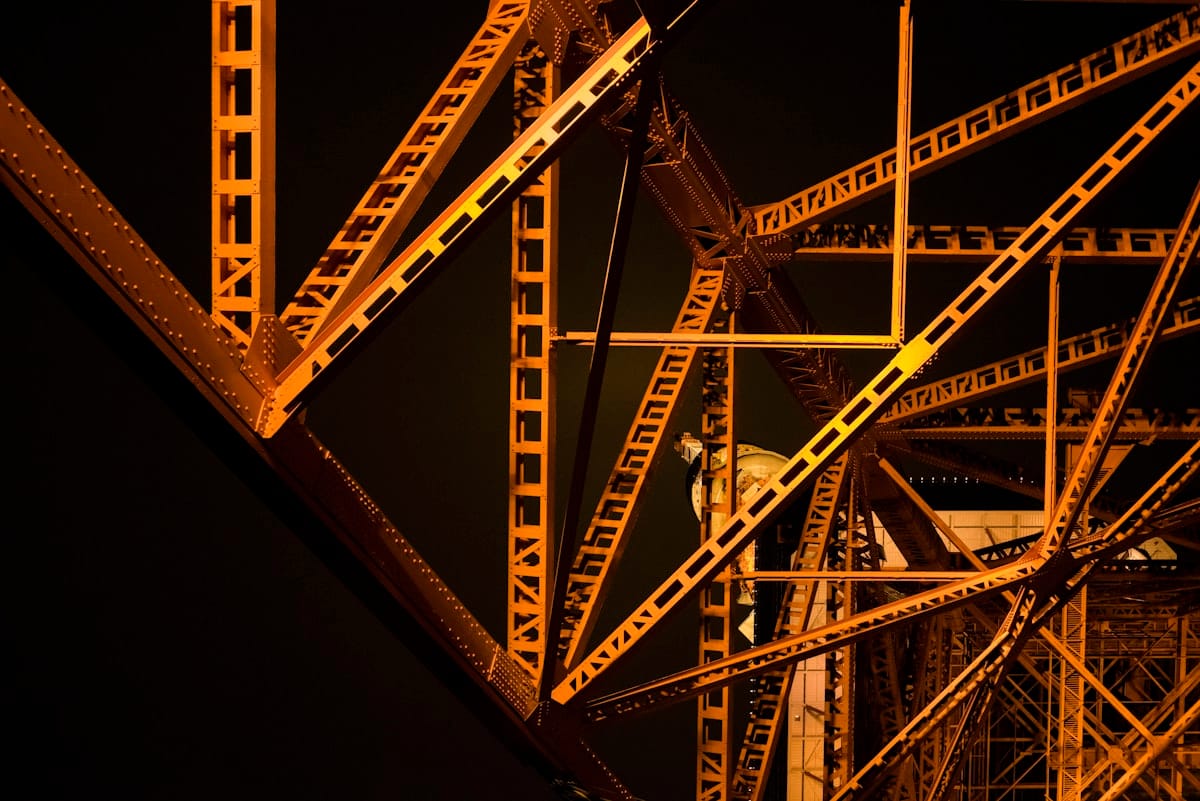
Look at any steel structure and you’ll notice it isn’t solid blocks, it’s letter-shaped profiles bolted and welded together. That shape isn’t decoration, it’s the whole trick. A structural steel shape puts the metal exactly where the load needs it and leaves it out everywhere else, so you get maximum strength for minimum weight. Here are the shapes you’ll actually meet, what each one does, and how an engineer picks between them.
What is a structural steel shape?
A structural steel shape is the standardized cross-section steel is rolled into to carry load. Around 80% of the structural components in heavy machinery are joined by arc welding on these shapes (Gitnux, 2026). The cross-section is what matters: the flanges resist bending, the web resists shear, and hollow sections resist twist.
These sections are standardized by AISC, with dimensions, weight per foot and properties like moment of inertia and section modulus tabulated, so an engineer designs straight from the tables. For the material behind the shapes, see what is structural steel, and for the strength ratings, structural steel grades.
The seven cross-sections at a glance
Almost everything is built from seven profiles. Once you can recognize the cross-section, you can read a steel drawing.
Each structural steel shape and its job
W-shape (wide flange)
The W-shape is the workhorse: two wide, parallel flanges and a vertical web, with the best strength-to-weight ratio for beams and columns. Since 1998 the standard grade for W-shapes has been ASTM A992 (Wikipedia). Don’t confuse a beam with a girder, though; we untangle that in I-beam vs girder.
S-shape (American Standard I-beam)
The S-shape is the classic “double-T” with narrower, inward-sloping flanges. It shows up in rails, monorails and older structures, but the W has largely replaced it for new beams.
HP-shape (bearing pile)
The HP has flanges and web of equal thickness and a nearly square section, so it takes hammer impact and axial load as a driven pile in deep foundations.
Channel (C and MC)
The channel is a “U”: a web with two flanges on one side. It suits purlins, girts, light frames and platform edges, and pairs up to form built-up members.
Angle (L)
The angle is two legs at 90 degrees, the shape of bracing, truss members, supports and connections. Equal or unequal legs suit the load.
HSS (hollow structural section)
The HSS is square, rectangular or round tube. Its closed section resists torsion far better than an open shape and looks clean, so it’s used for exposed columns, pipe racks and railings. The usual grade is ASTM A500.
Plate, bar and tee
Plate forms base plates, gussets and connections; bar makes tie rods and anchors; the tee is half a W and serves as a truss chord.
Why a shape beats a solid bar
Here’s the physics in one picture. A wide-flange beam and a solid bar can weigh the same per foot, yet the beam carries several times the bending load. Why? Because bending stress is highest far from the center, so putting the steel out in the flanges, where it works hardest, and thinning the web, where it barely helps, is free strength.
How structural steel shapes are named
The naming looks like code but it’s simple. A “W12x26” is a W-shape about 12 inches deep that weighs 26 pounds per foot. An “HSS6x6x1/4” is a 6-by-6-inch square tube with a quarter-inch wall. In metric the weight is kg per meter. With that name, any shop knows exactly what to cut, drill and weld.
How to choose the right structural steel shape
The shape follows the job, and the job is the type of load. A beam works in bending, so W-shapes win on section modulus. A column works in compression, so W-shapes or HSS tubes serve depending on buckling and looks. Bracing uses angles and channels. And to span far, a truss combines angles, tubes and tees.
At TAS we fabricate and erect all of these to spec in our structural steel service, and every joint is made by our industrial welding team to AWS D1.1. Then it comes down to the connection, which we cover in structural steel connections.
Which steel grade each shape uses
Shape and grade are chosen together. W-shapes are usually A992 (345 MPa), plates, angles and bars run in A36 (250 MPa), HSS tubes are A500, and A572 steps in for high strength at low weight. The full breakdown is in our guide to structural steel grades, and it’s why a fabricator can’t swap one member for another that just “looks the same”.
- A structural steel shape is the standardized cross-section rolled to carry load.
- Seven profiles cover almost everything: W, S, HP, C, L, HSS and plate/tee.
- Each has a job: W for beams and columns, HSS for torsion, angles and channels for bracing.
- The shape beats a solid bar by moving steel to the flanges, where bending stress is highest.
- Naming (W12x26, HSS6x6x1/4) gives depth, weight and wall thickness.
- Shape pairs with grade: W is A992, plate is A36, tube is A500.
Frequently asked questions
Need structural steel shapes fabricated to spec?
TAS cuts, fits and welds beams, columns and structures to AWS D1.1 and ASTM across Sint Maarten and the Caribbean.
Request a quoteView structural steel EN
EN ES
ES