
Repair or replace a storage tank? A decision guide
Repair a storage tank when the damage is local, the remaining metal is enough for the service life you need and the repair costs clearly less than a new tank. Replace it when corrosion is widespread, the corrosion rate leaves too little life or repeated repairs keep adding up. The deciding numbers come from an inspection: thickness readings and a corrosion rate (CommTank).
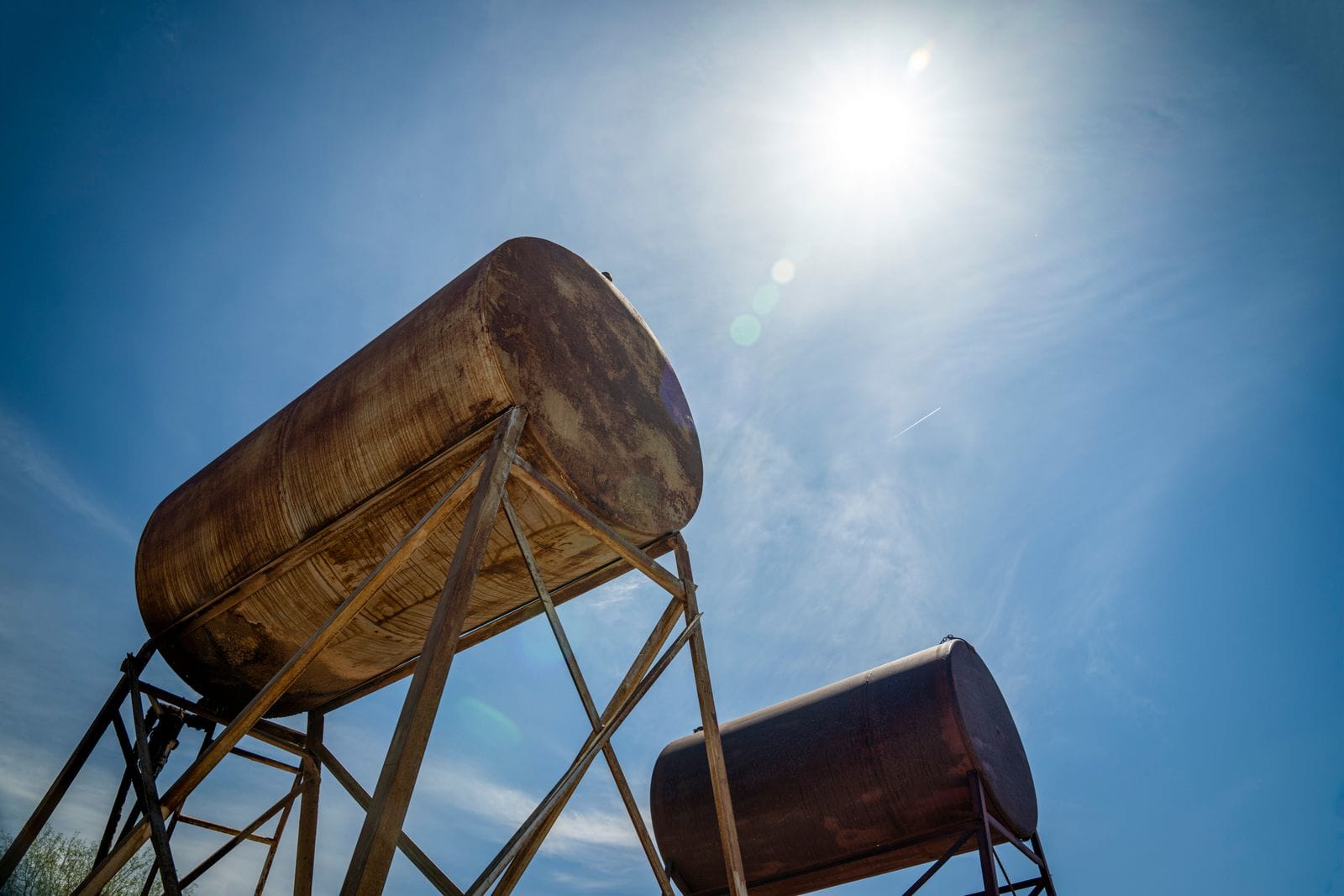
An old tank with rust streaks and a weeping seam puts an owner in a spot. Patch it and hope, or commit real money to a new one? Rust on the outside is a poor guide. Some tanks look terrible and have plenty of steel left. Others look fine and are thin on the floor where nobody can see. This guide sets out what we’d want to know before recommending either route, and how the numbers usually split the decision. It builds on our API 653 inspection intervals guide and our corrosion inspection checklist.
One caution on sources. API 653 is a paid standard, so where we quote its logic we do it as inspector training material and trade guides describe it. Your authorized inspector applies the actual text of your edition.
What data do you need before deciding?
You need measured thickness across the shell, roof and floor, and a corrosion rate worked out from them. Inspectors take ultrasonic thickness readings and compare them with the original design thickness to project remaining life (CommTank). Without that projection, both “repair” and “replace” are guesses.
Three more items round out the picture: the condition of the foundation and any settlement, the state of the roof and its drains, and the tank’s service history, including what it holds, at what temperature and whether the product has changed. A tank that has been through a product change or a hurricane deserves a closer look than its age suggests.
The logic in the diagram is simple. If the calculated thickness at the next inspection stays above the minimum, the tank stays in service and you set the next date. If it doesn’t, the options are to repair, line, shorten the interval or replace. In inspector training material for the floor, that is how the bottom-plate check is framed. Cost and downtime then pick among the options that are technically acceptable.
Which factors point to repair, and which to replace?
Local damage that leaves the rest of the tank sound favors repair. Widespread thinning, a short remaining life or repair costs approaching the price of a new tank favor replacement. The table sets the common factors side by side, so you can see where your tank falls.
| Factor | Leans toward repair | Leans toward replacement |
|---|---|---|
| Extent of corrosion | Localized pitting or one damaged area | Thinning across most of the floor or shell |
| Remaining life | Enough for the service life you need | Too short to justify the repair spend |
| Where the damage is | Roof, nozzles, a few shell plates | Floor plates throughout, or a lower shell course |
| Foundation | Sound, settlement within limits | Settled or eroded, and the fix costs as much as the tank |
| Future duty | Same product, same capacity | You need more capacity or a different product |
| Downtime | Days, with a bypass or a second tank | Weeks, and you can plan for them |
What does the cost gap look like?
One published example puts a repair on a 15,000-gallon tank at roughly $24,000 and four days, against $80,000 or more and about six weeks for a replacement, plus potential production losses near $30,000 (CommTank). That’s a builder’s own write-up of a small fuel tank, so don’t carry the dollar figures over to a large process tank. The ratio is the useful part.
Repairs stay cheaper only while they stay contained. If you’re on the third floor patch in five years, add those up against the replacement. Ask for the repair history to be tallied that way before you sign off on the next one.

Why is the floor the deciding question?
Tank floors corrode from underneath, where you can’t see them, and the floor is the most expensive part to replace in place. The commonly cited API 653 rule for the critical zone near the shell is the smaller of half the original floor thickness or half the required thickness of the lowest shell course, but not less than 0.1 in (2.5 mm). Treat that as a pointer, not a substitute for the standard, and confirm it against your edition with your inspector.
Once the calculated remaining thickness heads below the minimum, patching plates on a wide area quickly stops making sense. Lining the floor, overlaying it or renewing it becomes the discussion. Lifting a tank to replace the floor is engineered work in its own right, so it belongs in a plan, not in a field decision. It also sits in the tank repair scope, where a repaired tank may need a water test like the one in our hydrostatic testing guide.
What’s a sensible order of work?
Get the data first, price the options over the same horizon, then decide. Skipping the order is how owners end up repairing a tank that should have been replaced, or replacing one that had ten good years left.
Ultrasonic thickness on shell and roof, and floor scanning during an internal inspection, with the results in one report.
Use the corrosion rate to see when each part reaches its minimum thickness.
Foundation, roof, drains, nozzles and appurtenances all change the price of keeping a tank.
Compare repair, lining and replacement over the same number of years, including downtime.
Product storage, hot work permits, gas-free testing and a test plan after the work.
Keep the data, the decision and the reason together for the next inspector.
What changes on a Caribbean site?
Salt air, heat and humidity attack the coating first and the steel second, so a failed coating is your early warning, not just a cosmetic issue. Lead times matter too. Plate, a certified inspector and a repair crew often have to be brought in by sea or air, which stretches downtime and pushes owners to time repairs around the storm season. When the decision is close, that logistics premium tends to favor a well-planned repair now over an emergency one later.
If the tank turns out to be past saving, a new build follows the path in how an API 650 tank is built, and the choice of roof type is covered in our guide to storage tank types. The wider standards picture is in API 650 vs 620 vs 653.
- The decision comes from measured thickness and a corrosion rate, not from how the tank looks.
- Local damage and enough remaining life favor repair. Widespread thinning favors replacement.
- Repairs are cheaper only while they stay contained. Tally the repair history.
- The floor is often the deciding item, because it corrodes unseen and costs the most to renew.
- Price every option over the same horizon, including downtime.
- Downtime you can’t afford usually decides the route more than the steel does.
Frequently asked questions
Need a repair-or-replace opinion on a tank?
Tasweldermechanics repairs and rebuilds above-ground storage tanks to API standards across the Caribbean, mobilized from Sint Maarten. Tell us what you found.
Request a quoteView tank repair EN
EN ES
ES